
Blog
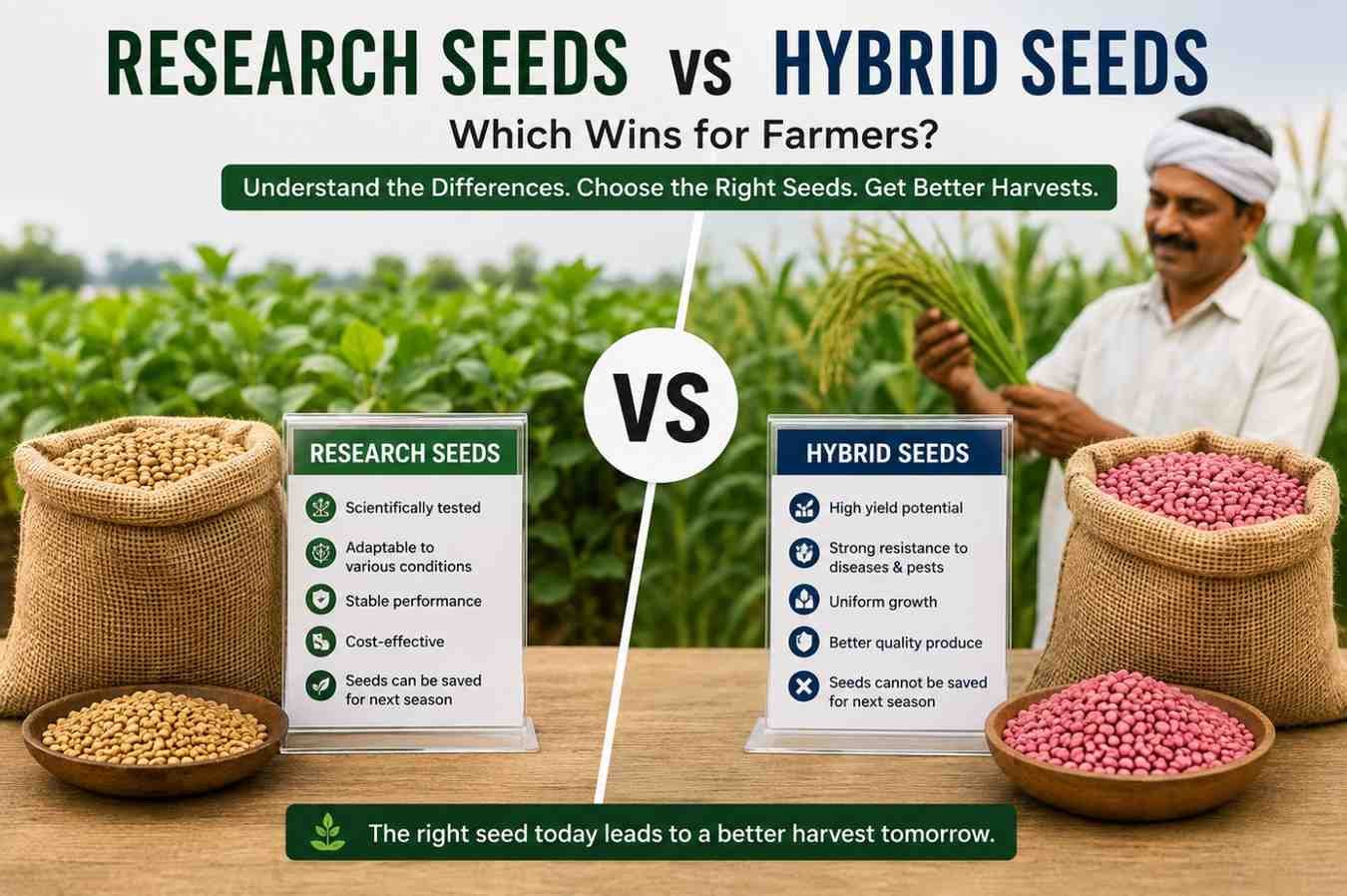
Research Seeds vs Hybrid Seeds: Which Wins for Farmers?
Research Seeds vs Hybrid Seeds: Which Wins for Farmers?
Introduction
Picking the right seed is the first step to a good harvest. Farmers grow many crops like wheat, mustard, moong, bajra, vegetables, and fodder. The quality of the seed decides how well the crop grows. It also affects how much food the farmer gets in the end. Many farmers wonder if they should choose research seeds or hybrid seeds. Both types of seeds are useful in farming today. But they work in different ways and give different results. Knowing these differences helps farmers pick the best seed. This choice depends on their land, weather, and farming goals.
This guide will explain research seeds and hybrid seeds simply. You will learn their benefits and their limits too. By the end, you will know which seed suits you best.
Learn more about research seeds in our complete Research Seeds Guide for Better Harvests.
What Are Research Seeds?
Research seeds are special seeds that scientists make after many years of hard work. Scientists study and test these seeds many times in real farms. They pick seeds that can fight plant diseases, survive with less water, and still grow well every year. Before farmers can use these seeds, they are tested again and again to make sure they are safe and strong. Scientists want to give farmers good seeds that grow well in any weather. These seeds help farmers grow more crops and worry less about failure.
How Research Seeds Are Developed
Making new seeds for farmers takes a lot of careful work. Plant scientists look at thousands of different seed types to find the best ones. They plant these seeds in many different places, like hot areas, dry areas, and rainy areas, to see how well they grow. This helps them know which seeds work best in each kind of weather and soil. Scientists also watch the plants grow for many years in a row, not just once. They check things like how tall the plants get, how much food they produce, and if bugs or sickness can hurt them. All this checking and testing helps scientists find the strongest and healthiest seeds. Good seeds can help farmers grow more food for everyone to eat.
Only the varieties that consistently demonstrate superior characteristics are approved for commercial use.
What Are Hybrid Seeds?
Hybrid seeds are made by mixing two special parent plants together. Farmers pick these parents very carefully. This special mixing is called crossing, and it gives the best qualities from both plants to their babies, or offspring. Because of this, hybrid seeds grow into strong and healthy plants. They also grow evenly, so all the plants look similar in size. Most importantly, hybrid seeds can produce much more food than regular seeds. That is why so many farmers around the world love using them.
Hybrid Seed Development Process
Plant breeders pick parent plants that are good at different things. One plant may grow tall and strong. Another may fight off pests well. A third may give better quality grain. Breeders choose plants like these to combine their best features. Then they carefully cross these parent plants together under controlled conditions. This crossing produces new seeds called F1 hybrid seeds. These are the first generation of baby plants from the cross. Something amazing happens when these hybrid seeds grow into plants. The new plants often grow better than either of their parents. Scientists call this special strength hybrid vigor. Its scientific name is heterosis, a big word for a simple idea.
Key Differences Between Research Seeds and Hybrid Seeds
|
Point |
Research Seeds |
Hybrid Seeds |
|
Made by |
Scientists, tested many times |
Mixing two parent plants |
|
Crop result |
Steady and reliable crops |
Bigger and faster growing crops |
|
Cost |
Costs less money |
Costs more money |
|
Reuse |
Farmers can save and reuse seeds |
Cannot be saved for next time |
|
Appearance |
May vary a little |
All plants look same in size, shape, and color |
|
Strength |
Adjusts well to different weather |
Gives the highest amount of crops |
Advantages of Research Seeds
Reliable Research and Testing
Research seeds undergo extensive testing before reaching farmers. This comprehensive evaluation ensures dependable field performance.
Better Adaptability
These varieties often adapt well to varying climates, soil conditions, and cultivation practices.
Stable Performance
Research seeds are special seeds that scientists have tested carefully. Farmers like using these seeds because they grow the same amount of crops almost every year. This means farmers can trust these seeds season after season. Even when the weather changes a little, these seeds still give good, steady results. That is why many farmers choose research seeds for their farms.
Cost-Effective
Some seeds cost less money than hybrid seeds. This makes them a good choice for farmers who do not have a lot of money to spend. These farmers can still grow good crops without spending too much. Saving money on seeds means they have more money for other things, like tools or water for their farms.
Advantages of Hybrid Seeds
Higher Yield Potential
Hybrid seeds are specifically bred to maximize productivity. Under proper crop management, they can produce significantly higher yields.
Disease and Pest Resistance
Hybrid plants are special because farmers make them stronger. Many hybrid varieties possess enhanced resistance to common diseases and insect attacks, reducing crop losses. This means these plants get sick less often than normal plants. Insects also find it harder to damage them and eat their leaves. Because of this, farmers do not lose as many crops. They can grow more food and earn better money from their farms. This is why many farmers today prefer to grow hybrid seeds.
Uniform Crop Growth
Hybrid plants are special plants that farmers grow from two different parent plants. Scientists mix the best parts of each parent to make a new, better plant. One great thing about hybrid plants is that they usually grow at almost the same speed as each other. This makes it much easier for farmers to take care of their fields. Since all the plants grow together, farmers can water them at the same time without wasting water. Harvesting is also simpler because the crops are ready together, not at different times. This saves farmers a lot of time, effort, and money every season.
Improved Market Quality
Hybrid crops often grow better looking grains that people like to buy. These grains can be bigger, have nicer colors, and better shapes than regular crops. Farmers grow hybrid seeds because they give more food from the same land. Better looking crops help farmers earn more money at the market. This happens because buyers pay higher prices for good quality grains.
Challenges of Research Seeds and Hybrid Seeds
Research Seed Limitations
Research seeds do not always grow as much food as hybrid seeds. Hybrid seeds are specially made to give very high amounts of crops. Research seeds are more natural and not changed as much. Because of this, they may produce less food in some fields. Weather, soil, and water can also change how well they grow. A farm in one place may get good results, but another farm may not. This happens because every field has different growing conditions.
Hybrid Seed Limitations
Hybrid seeds usually cost more money than regular seeds. Farmers cannot save seeds from hybrid plants to use again. This is because saved hybrid seeds often grow weaker plants next season. So every year, farmers must buy new hybrid seeds. This helps them get strong, healthy crops each time.
Which Seed Type Is Best for Different Crops?
Cereals
Hybrid maize and bajra plants usually grow taller and give more grains.
Pulses
Research seeds grow well in moong and urad because they adapt easily.
Oilseeds
Mustard and other oilseed crops come in two seed types: research and hybrid. Farmers pick the type that suits their region best.
Fodder Crops
Hybrid fodder varieties often produce abundant biomass, making them ideal for livestock feed.
Vegetables
Hybrid vegetable seeds are popular because they grow uniform, high-quality fruits. Their good looks and quality create high market demand.
Factors to Consider Before Choosing Seeds
Climate
Choose seed varieties suitable for your local temperature and rainfall patterns.
Soil Health
Healthy soil improves germination, nutrient uptake, and crop growth regardless of seed type.
Water Availability
Some varieties require more irrigation than others. Select seeds based on available water resources.
Farming Goals
Choose hybrid seeds for maximum production, or research seeds for steady, affordable performance.
Budget
Consider both seed costs and expected returns before making your decision.
Research Seeds vs Hybrid Seeds Comparison Table
|
Criteria |
Research Seeds |
Hybrid Seeds |
|
Development |
Scientific breeding |
Controlled cross-breeding |
|
Yield Potential |
Good |
Very High |
|
Uniformity |
Moderate |
Excellent |
|
Disease Resistance |
Good |
Excellent |
|
Cost |
Lower |
Higher |
|
Seed Saving |
Usually possible |
Generally not recommended |
|
Adaptability |
High |
Good |
|
Profit Potential |
Moderate |
High with proper management |
Frequently Asked Questions
Are research seeds better than hybrid seeds?
Research seeds aren't necessarily better — it depends on the farmer's needs. Research seeds are cheaper and give steady results. Hybrid seeds cost more but usually give higher yields.
Can farmers save hybrid seeds for next season?
Not really. Hybrid seeds don't grow the same good quality plants in the next season. Farmers usually need to buy new hybrid seeds every year for best results.
Why are hybrid seeds more expensive?
Their production involves controlled pollination, specialized breeding programs, and strict quality assurance processes.
Which seeds produce higher yields?
Hybrid seeds usually produce higher yields than research seeds. This is why many farmers pick hybrid seeds for bigger harvests.
Are research seeds suitable for small farmers?
Yes, research seeds are a good choice for small farmers. They cost less money and give steady, reliable results every season.
Conclusion
There is no single best answer when choosing between research seeds and hybrid seeds. Each type helps farmers in a different way. Research seeds are steady, low-cost, and tested for many years, so farmers can trust how they will grow.
Hybrid seeds often grow more crops, look more alike, and can sell for a better price when cared for the right way. The right seed depends on the crop, the weather, and what the farmer wants to grow.
Learning about both seed types helps farmers grow more food and earn more money. Good seeds start with a trusted seller. That is the first step to a strong, healthy harvest.
Ready to Choose the Right Seeds?
Contact AgriRaise Crop Care today and grow a better harvest!

Leave a comment


Comments(0)