
Blog
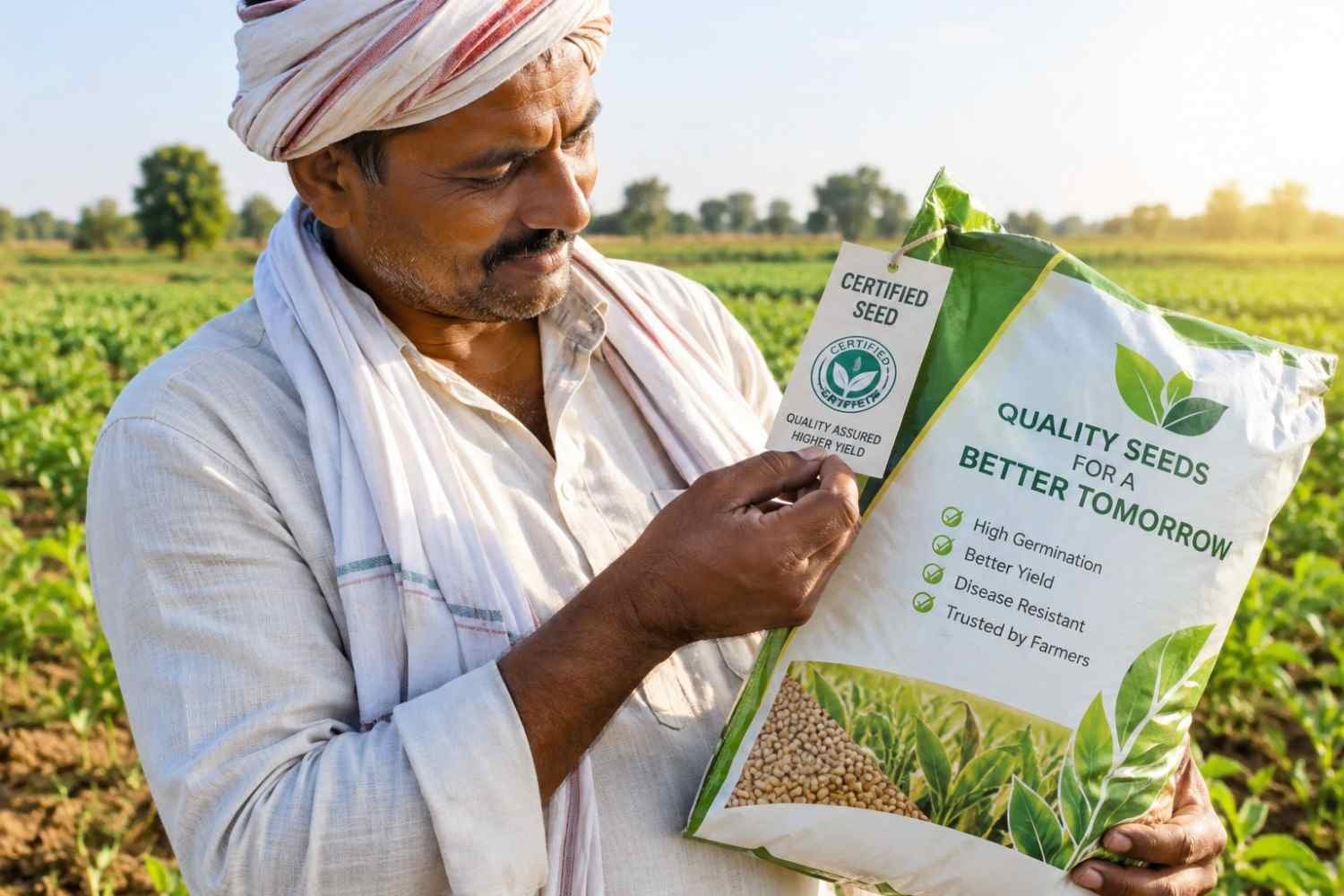
How to Identify & Buy Genuine Certified Seeds
Introduction
Buying seeds is one of the first decisions a farmer makes each season. Get it wrong, and the whole crop suffers before it even sprouts.
Fake or uncertified seeds cost Indian farmers crores every year. Poor germination, weak plants, and low yield are the usual results.
This guide shows you exactly where to buy certified seeds, how to check if seeds are genuine, and what mistakes to avoid. To understand their importance, read our detailed guide on benefits of certified seeds for higher crop yield. Whether you are a smallholder farmer, a dealer, or an agri-input buyer, this article gives you a clear, practical process to follow.
Quick Answer
To buy certified seeds, look for the official certification tag with a lot number, purchase only from licensed dealers or government seed corporations, and check the seed packet for a valid certification agency seal. Always ask for a bill and match the lot number with the tag before payment.
Table of Contents
- What Are Certified Seeds
- Why Certified Seeds Matter
- Where to Buy Certified Seeds
- How to Identify Genuine Certified Seeds
- Certified vs Truthfully Labelled vs Uncertified Seeds
- Step-by-Step Guide to Buying Certified Seeds
- Benefits of Buying Certified Seeds
- Expert Tips
- Common Mistakes to Avoid
- Key Takeaways
- Conclusion
- FAQ
What Are Certified Seeds
Certified seeds are seeds that have passed government-approved quality checks for genetic purity, germination rate, and physical purity.
A certification agency inspects the seed crop in the field and again after processing. Only seeds that meet the minimum standards get a certification tag.
This tag is proof. It tells you the seed variety, the source, the germination percentage, and the batch or lot number.
Why Certified Seeds Matter
Seed quality decides almost half of your final yield potential. The rest depends on soil, water, and management.
Here is what certified seeds guarantee that ordinary seeds cannot:
- Verified germination percentage, usually above 70-85% depending on crop
- True-to-type variety, so the crop matches what is promised on the label
- Freedom from major seed-borne diseases
- Consistent plant growth and maturity, which helps with harvesting and spraying schedules
- Traceability, so any quality issue can be tracked back to the source
Farmers who use certified seeds often report more uniform germination and fewer gap-filling replantings.
Where to Buy Certified Seeds
This is the part most farmers get wrong. Buying from an unknown source, even at a lower price, is a risk that can cost the entire season.
Trusted Sources for Certified Seeds
|
Source |
What to Expect |
Best For |
|
State Seed Corporations |
Government-certified, subsidized rates |
Staple crops like paddy, wheat |
|
Licensed Private Seed Companies |
Certified hybrid and OP varieties |
Vegetables, cotton, oilseeds |
|
National Seeds Corporation (NSC) |
Certified breeder and foundation seeds |
Large-scale farming |
|
Authorized Agri-Input Dealers |
Local access, certified stock from companies |
Everyday farm needs |
|
Krishi Vigyan Kendras (KVKs) |
Certified seeds with agronomic advice |
New varieties, trial plots |
|
Company Direct Sales / Agri Raise Crop Care |
Certified seeds with quality testing records |
Farmers wanting direct traceability |
Always confirm the dealer holds a valid seed license under the Seeds Act, 1966. You can ask to see this license before buying.
How to Identify Genuine Certified Seeds
Fake seed packets are made to look almost identical to real ones. Here is how to tell them apart.
Check the Certification Tag
Every certified seed bag must carry a tag, usually blue or green in color, with these details:
- Crop and variety name
- Lot number
- Date of testing
- Germination percentage
- Certification agency name and seal
- "Certified Seed" or "Truthfully Labelled Seed" clearly printed
Match the Lot Number
The lot number on the tag must match the number printed on the bag. If these two numbers do not match, do not buy the seed.
Look for the Seal, Not Just the Sticker
A genuine certification seal is embossed or printed by the certification agency. A loose paper sticker that can be peeled off easily is a red flag.
Check the Bag Stitching and Packaging
Genuine seed companies use tamper-proof stitching. If the bag looks re-stitched or the packaging is loose, be cautious.
Ask for the Bill
A proper bill with the dealer's GST number, batch number, and date protects you if there is a quality complaint later.
Certified vs Truthfully Labelled vs Uncertified Seeds
Farmers often confuse these three categories. Here is the difference in one table.
|
Type |
Government Testing |
Traceability |
Risk Level |
|
Certified Seeds |
Yes, field and lab tested |
Full, lot-based |
Low |
|
Truthfully Labelled Seeds |
Company self-declared, spot-checked |
Partial |
Medium |
|
Uncertified / Loose Seeds |
None |
None |
High |
Certified seeds carry the lowest risk because an independent agency, not just the company, has verified the quality.
Step-by-Step Guide to Buying Certified Seeds
- Identify your crop and variety needs. Check what performs well in your soil and climate zone before shopping.
- Shortlist licensed dealers or seed corporations. Ask neighbouring farmers or your local Krishi Vigyan Kendra for referrals.
- Check the certification tag on the bag. Confirm lot number, germination percentage, and agency seal.
- Verify the dealer's license. A licensed dealer will show this without hesitation.
- Buy only the quantity needed for the season. Fresh seed lots germinate better than old stock.
- Collect the bill and keep the tag. Store both until harvest, in case you need to raise a quality complaint.
- Do a small germination test at home. Soak 100 seeds in a wet cloth for a few days and count how many sprout.
Benefits of Buying Certified Seeds
|
Benefit |
Impact on Farming |
|
Higher germination rate |
Fewer gaps in the field, less resowing cost |
|
Genetic purity |
Uniform crop, easier harvesting |
|
Disease-free stock |
Lower risk of seed-borne infection |
|
Better yield potential |
Higher income per acre |
|
Traceability |
Easy resolution if seed quality fails |
Expert Tips
- Buy seeds only a few weeks before sowing. Seeds lose vigor if stored too long in humid conditions.
- Store seed bags in a cool, dry place, away from direct sunlight, until sowing day.
- Compare germination percentage across brands before deciding, not just price.
- If sowing a large area, test a small sample bag first before buying in bulk.
- Keep the certification tag safe. It is your proof of purchase quality, not just the bill.
Common Mistakes to Avoid
- Buying seeds from unlicensed roadside sellers to save a small amount of money
- Ignoring the certification tag and trusting only the brand name
- Not checking the germination date printed on the tag
- Throwing away the tag and bill right after purchase
- Buying seeds far in advance and storing them poorly before sowing
- Choosing a variety without checking suitability for local soil and rainfall
Key Takeaways
- Certified seeds are lab and field tested by an independent agency, not just the seed company.
- Always buy from licensed dealers, state seed corporations, or trusted seed companies.
- Check the certification tag, lot number, and seal before every purchase.
- Keep your bill and tag until after harvest.
- A small home germination test can confirm quality before large-scale sowing.
Conclusion
Certified seeds are the foundation of a good harvest. A few extra minutes spent checking the tag, the seal, and the dealer's license can save an entire season of hard work.
Agri Raise Crop Care Pvt. Ltd. follows strict internal quality testing and sources only certified seed stock, so farmers can sow with confidence.
Call to Action
Ready to sow with confidence? Choose certified seeds from a trusted source and give your crop the strongest possible start. Visit your nearest authorized Agri Raise Crop Care dealer or contact us directly to check seed availability for your region.
FAQ
How can I verify the source of seeds for seed certification?
You can verify the source by checking the certification tag, label details, and buying from authorized dealers.
How can we identify good quality seeds?
Good seeds are clean, uniform, disease-free, and have a high germination rate with a certified tag.
Which seed has 100% genetic purity?
No seed has 100% purity, but certified seeds maintain very high genetic purity.
What is the difference between registered seed and certified seed?
Foundation seeds have basic quality, while certified seeds are fully tested and more reliable.
Which company is best for seeds in India?
Choose a company that offers certified seeds, good quality, and farmer support like Agriraise.
What color is the certification tag for certified seeds?
The certification tag color is blue for certified seeds.
Who certifies seeds in India?
Seeds are certified by State Seed Certification Agencies (SSCA) under government rules.
Which seed is exempted from certification?
Truthfully Labelled (TL) seeds are exempted from certification but must meet quality standards.

Leave a comment


Comments(0)