
Blog

Barley Seed Rate per Acre: Sowing & Planting Guide (2026)
The ideal barley seed rate per acre is about 40 kg (100 kg per hectare) for timely-sown irrigated crops. Late-sown barley needs about 50 kg per acre. Malt barley requires around 30–35 kg per acre. This barley sowing rate may vary depending on seed size, germination, and soil moisture.
Introduction
Barley seed rate decides how well your crop stands in the field. Too little seed leaves gaps and lets weeds grow. Too much seed crowds plants and wastes money.
Many farmers sow by habit, not by calculation. That is why two fields with the same seed can give very different yields. The right rate depends on your sowing time, water, and seed quality.
This guide gives clear numbers you can use this season. It also shows how to adjust them for your own field. For the full crop plan, read our barley farming guide (2026).
Table of Contents
- What Is the Ideal Barley Seed Rate per Acre?
- Barley Seed Rate per Hectare (Conversion Guide)
- Factors Affecting Barley Seed Rate
- Barley Sowing Method & Spacing
- Barley Seed Rate for Different Conditions (Irrigated vs Rainfed)
- Common Mistakes in Barley Seeding
- Key Takeaways
- FAQs on Barley Seed Rate
What Is the Ideal Barley Seed Rate per Acre?
The standard barley seed rate is 40 kg per acre for normal sowing. This gives a healthy plant stand under most Indian conditions. Always confirm the exact figure with your state agriculture university.
Seed rate for irrigated conditions
For timely-sown irrigated barley, use 40 kg per acre. Sow in rows for even germination. Irrigated fields have steady moisture, so this rate works well.
Seed rate for rainfed conditions
For rainfed barley, use about 40 kg per acre. Some regions suggest a slightly higher rate if moisture is low. Sow as soon as the soil has enough moisture.
Seed rate for different varieties
Seed size and use change the rate. Here is a simple guide:
|
Barley type |
Seed rate (kg/acre) |
Seed rate (kg/ha) |
|
Feed or food barley, timely sown |
40 |
100 |
|
Feed or food barley, late sown |
50 |
125 |
|
Malt barley |
30–35 |
75–87 |
Malt barley uses less seed. This keeps grains uniform in size, which maltsters prefer. Check the recommendation for your chosen variety before you buy.
Barley Seed Rate per Hectare (Conversion Guide)
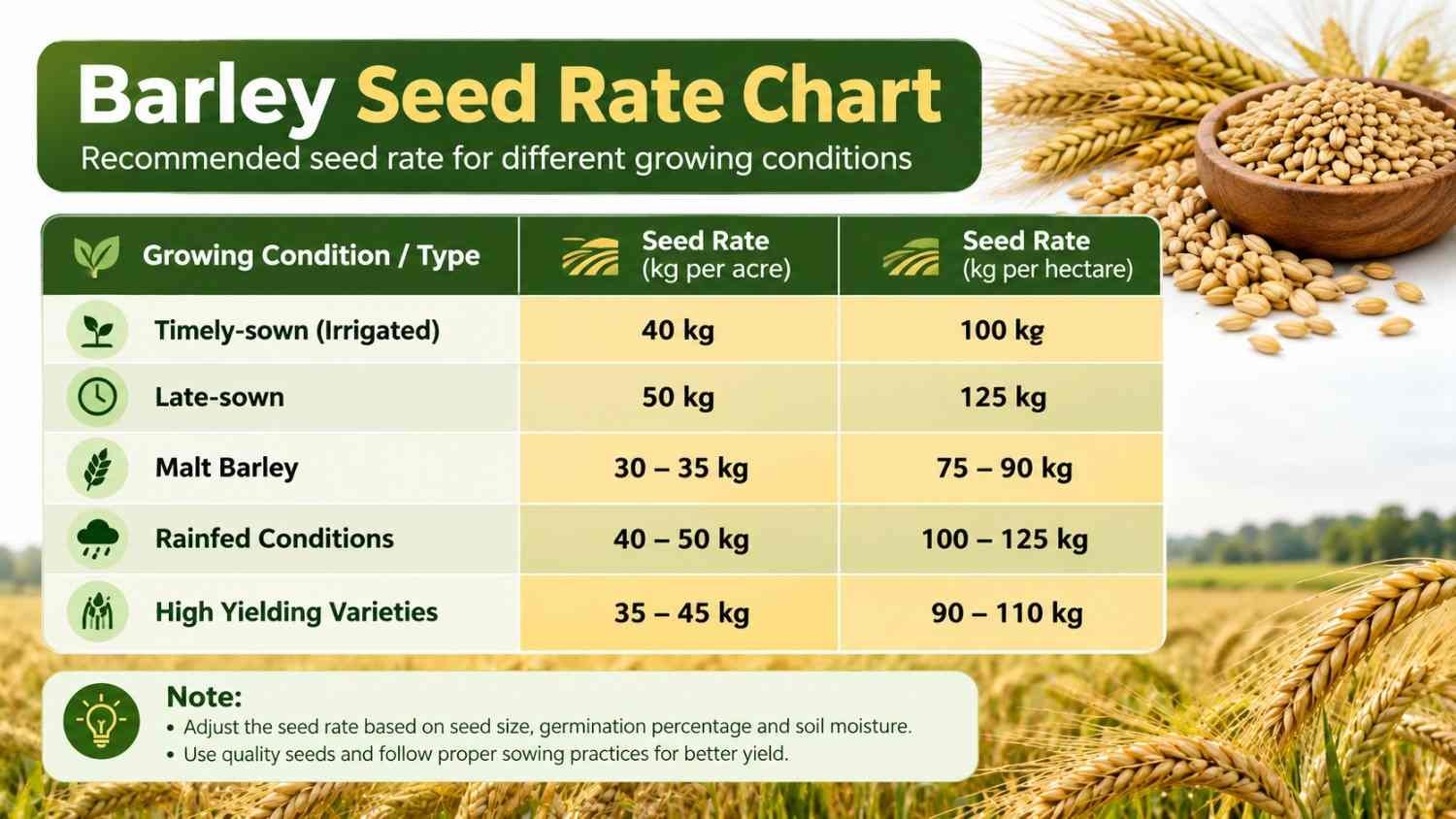
One hectare equals about 2.47 acres. To convert, divide the hectare figure by 2.47. A seed rate of 100 kg per hectare becomes about 40 kg per acre.
Use this quick table:
|
Per hectare |
Per acre (approx.) |
|
75 kg |
30 kg |
|
100 kg |
40 kg |
|
125 kg |
50 kg |
Example: You have 3 acres of irrigated land, sown on time. Multiply 40 kg by 3. You need about 120 kg of seed.
Factors Affecting Barley Seed Rate
The table rate is a starting point. Your field and seed can push it up or down. Check these three things first.
Soil type
Fertile, well-prepared soil supports good germination at the standard rate. Heavy or crusted soil can block seedlings. Light, sandy soil dries fast, so sow on time and keep depth right.
Climate
Barley is a cool-season crop. Late sowing in warm weather shortens the growing period. Plants tiller less, so farmers raise the seed rate by about 25%.
Seed quality and germination rate
Low germination means fewer plants per square metre. Always check the germination percentage on the seed bag. Use certified seed whenever you can. Always use certified barley seed. It comes with a tested germination percentage and purity level, so you can calculate your seed rate with confidence.
You can adjust the rate with this formula:
Seed rate (kg/ha) = (Target plants per m² × 1000-grain weight in g) ÷ (Germination % × Purity %) × 10
Example: Target 250 plants per m². Grain weight is 40 g. Germination is 90% and purity is 98%.
- Seed needed at 100% quality: 250 × 40 ÷ 1000 = 10 g per m², or 100 kg per hectare.
- Divide by 0.90 × 0.98 = 0.882.
- Adjusted rate: about 113 kg per hectare, or 46 kg per acre.
This example is for illustration. Use your own seed test results.
Barley Sowing Method & Spacing
Good seed rate needs good sowing. Use a seed drill for even spacing. Broadcasting wastes seed and gives uneven stands.
Row spacing for barley
Keep row spacing at 22 to 23 cm for timely sowing. For late sowing, reduce it to about 18 to 20 cm. Closer rows help late crops cover the ground faster.
Seed depth
Sow seed 5 to 6 cm deep in moist soil. Too shallow, and seed dries out. Too deep, and seedlings struggle to emerge. In dry rainfed soil, you may go slightly deeper to reach moisture.
Best sowing time
Timely sowing for irrigated barley in North India is the first fortnight of November. Late sowing can go into December. Rainfed barley should be sown from late October to early November, once moisture is available.
Barley Seed Rate for Different Conditions (Irrigated vs Rainfed)
The right barley seed rate changes with water and sowing date.
- Irrigated, timely sown: 40 kg per acre, 22–23 cm row spacing.
- Irrigated, late sown: 50 kg per acre, 18–20 cm row spacing.
- Rainfed: about 40 kg per acre. Sow early and use moisture-saving practices.
- Malt barley: 30–35 kg per acre for uniform grain.
Treat seed before sowing to protect against diseases such as loose smut. Follow the label and local expert advice for the right fungicide and dose.
Common Mistakes in Barley Seeding
Over seeding
Too much seed makes plants compete for light, water, and nutrients. Stems become weak and lodging risk goes up. It also raises your seed cost for no gain.
Low seed rate
Too little seed leaves gaps. Weeds fill these gaps quickly. Yield drops because fewer ear-bearing tillers form.
Wrong spacing
Rows that are too wide waste space. Rows that are too narrow slow airflow and invite disease. Use a calibrated seed drill and check it before sowing.
Another common error is skipping the germination check. Test a small sample first. It takes a few days and can save the whole crop.
Key Takeaways
- Standard barley seed rate: 40 kg per acre (100 kg per hectare).
- Late sowing: 50 kg per acre. Malt barley: 30–35 kg per acre.
- Divide hectare figures by 2.47 to get acres.
- Adjust the rate using germination and purity.
- Use 22–23 cm rows and 5–6 cm depth for timely sowing.
- Treat seed and calibrate your drill before sowing.
Ready to Sow with Confidence?
Good yield starts with good seed. Explore quality barley seed and crop care products from Agri Raise Crop Care Pvt. Ltd. and plan your season with our expert guidance.
FAQs on Barley Seed Rate
- What is the barley seed rate per acre?
The normal barley seed rate is 40 kg per acre for timely irrigated sowing. Late sowing needs about 50 kg per acre. Malt barley needs about 30 to 35 kg per acre. - What is the barley seed rate per hectare?
It is about 100 kg per hectare for timely sowing and 125 kg for late sowing. Malt barley uses 75 to 87 kg per hectare. - Does barley seed rate change for rainfed fields?
Yes, slightly. Rainfed fields use about 40 kg per acre, and sowing at the right moisture matters more than extra seed. - How deep should I sow barley seed?
Sow 5 to 6 cm deep in moist soil. In drier soil, go a little deeper to reach moisture. - What happens if I use too much barley seed?
Plants crowd each other and grow weak. Lodging and disease risk rise, and you pay more for seed. - What is the best row spacing for barley?
Use 22 to 23 cm for timely sowing. Use 18 to 20 cm for late sowing.

Leave a comment


Comments(0)