
Blog
What Are Good Quality Seeds and Why Do They Matter?
What Are Good Quality Seeds, and Why Do They Matter?
Agriculture begins with a single but crucial decision: choosing the right seed. Poor-quality seeds can severely reduce crop performance, regardless of soil or farming methods. This is why farmers around the world prioritize good quality seeds for farming to achieve better yields, healthier crops, and higher profitability.
Seeds are the foundation of crop production. They determine plant vigour, resistance to diseases, and overall productivity. Investing in quality seeds improves agriculture and ensures farm success.
What Are Good Quality Seeds?
Good quality seeds ensure healthy germination and strong crop growth. These seeds are carefully selected, tested, and often certified to meet quality standards.
What Is Meant by Good Quality Seeds?
Good quality seeds are pure, healthy, mature, and capable of producing vigorous seedlings. They are free from contaminants, diseases, and weed seeds. Such seeds have high germination rates and provide uniform crop establishment.
What Is the Concept of Seed Quality?
Seed quality refers to the overall value of a seed for planting purposes. It includes genetic purity, physical purity, germination capacity, moisture content, and seed health. High-quality seeds help farmers achieve consistent and profitable harvests.
Characteristics of Good Quality Seeds
Several factors determine whether a seed can be classified as high quality.
High Germination Rate
Germination rate is the percentage of seeds that successfully sprout under favourable conditions. Quality seeds ensure high germination rates, improving plant populations and minimizing replanting.
Genetic Purity
Genetic purity guarantees seed variety and unique traits. Pure seeds produce crops with predictable growth patterns, yield potential, and quality traits.
Disease-Free Seeds
Healthy seeds are free from seed-borne diseases and pathogens. Disease-free seeds reduce the risk of crop infections and improve overall field performance.
Proper Moisture Content
Seeds with proper moisture levels maintain viability during storage and transportation. Excess moisture can lead to fungal growth, while extremely dry seeds may lose vigor.
Physical Purity
Physical purity means seeds are free from foreign materials. Clean seeds ensure better planting efficiency and crop establishment.
Why Are Good Quality Seeds Important?
Quality seeds play a vital role in agricultural productivity and sustainability.
Higher Crop Yield
One of the most significant benefits of quality seeds is increased yield. Healthy seeds grow vigorous plants that efficiently use nutrients, water, and sunlight.
Better Resistance to Pests and Diseases
Many improved seed varieties are bred to resist common pests and diseases. This reduces crop losses and lowers the need for chemical treatments.
Uniform Crop Growth
Uniform germination and growth make crop management easier. Farmers can schedule irrigation, fertilization, and harvesting more effectively when crops grow consistently.
Improved Farm Profitability
Higher yields, improved quality, and lower costs boost farm profitability. Investing in quality seeds often generates significant returns.
How to Identify Good Quality Seeds?
Farmers should evaluate seeds carefully before purchasing and planting them.
Visual Inspection
Healthy seeds generally have a uniform size, shape, and color. Avoid seeds that appear shriveled, cracked, discolored, or damaged.
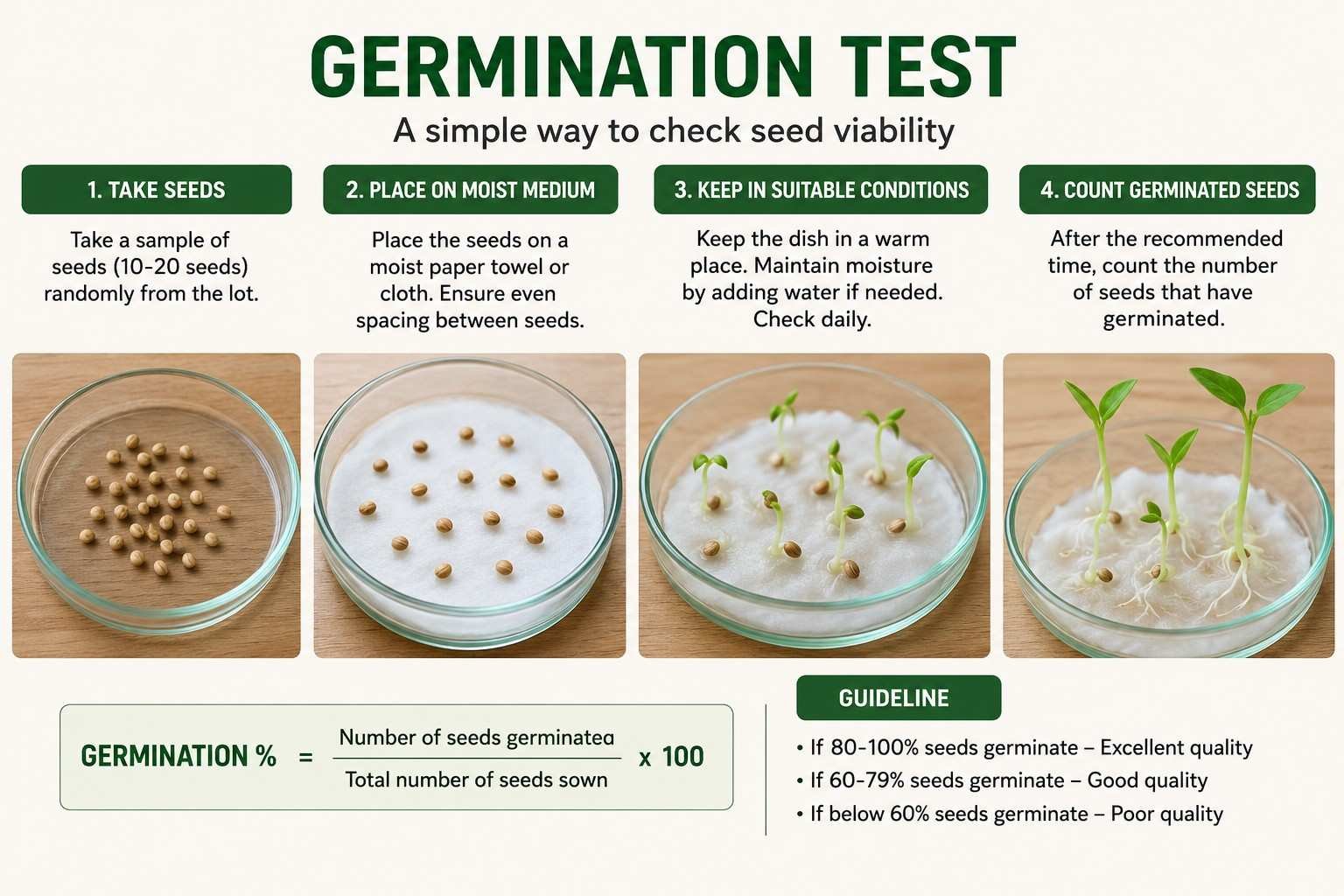
Germination Testing
A simple germination test can help determine seed viability. Place a sample of seeds in a moist environment and observe how many successfully sprout.
Seed Certification Labels
Certified seeds come with official labels indicating that they meet established quality standards. These labels provide information about germination percentage, purity, and variety.
How Are Good Quality Seeds Selected?
Selecting quality seeds requires attention to several important factors.
Choosing Certified Seeds
Certified seeds undergo strict quality testing and inspection. They offer greater assurance of purity, germination, and performance.
Checking Seed Source
Purchase seeds from reputable suppliers, seed companies, cooperatives, or agricultural institutions. Reliable sources are more likely to provide genuine and high-quality products.
Reviewing Variety Performance
Different varieties perform differently under various environmental conditions. Farmers should choose varieties suited to their region, climate, and farming objectives.
What Are the Best Quality Seeds for Farming?
Seed choice depends on crop type, climate, soil, and goals.
Certified Seeds
Certified seeds are among the most reliable options available. They are rigorously tested and produced in controlled conditions for quality.
Hybrid Seeds
Hybrid seeds are created by crossing parent lines for yield and disease resistance. They are widely used in commercial agriculture.
Improved Variety Seeds
Breeding programs develop improved varieties to boost productivity, adaptability, and stress resistance.
Common Mistakes Farmers Make When Buying Seeds
Avoiding common mistakes can help maximize crop performance.
Purchasing Uncertified Seeds
Buying uncertified seeds may result in poor germination, contamination, and lower yields. Always verify seed quality before purchase.
Ignoring Germination Rates
Some farmers focus only on price and overlook germination information. Low germination rates can reduce plant populations and overall productivity.
Choosing Price Over Quality
Cheaper seeds can lead to lower yields and more management issues. Quality should be the primary consideration.
Conclusion
Seeds are the starting point of every successful harvest. High-quality seeds ensure better germination, stronger growth, and higher productivity. Investing in quality seeds boosts crop performance and profitability.
Farmers prioritizing seed quality ensure sustainable production and success. Choosing certified, disease-free seeds maximizes land potential and ensures reliable harvests.
Frequently Asked Questions
Why are good quality seeds important?
Good quality seeds improve germination, crop establishment, disease resistance, and overall productivity, leading to better yields and profitability.
What do you mean by quality seed?
A quality seed is genetically pure, physically clean, healthy, and capable of producing vigorous seedlings under favorable conditions.
How to identify a good seed?
Good seeds are uniform in appearance, free from damage, and have high germination rates. Certification labels also help verify seed quality.
How do you know if seeds are good?
Good seeds are healthy, clean, and capable of producing strong plants. You can identify them by checking their size, color, and overall appearance. Quality seeds are undamaged, disease-free, pure, and have a high germination rate. Selecting certified seeds from a trusted supplier ensures quality and improved crop performance.
What are the qualities of a good seed?
A good seed has high germination, genetic purity, disease resistance, and strong growth. It helps produce healthy and uniform crops.
How are good quality seeds selected?
Quality seeds are chosen for certification, source reliability, germination, and local suitability.
What are the best quality seeds?
Certified, hybrid, and improved variety seeds are best for higher productivity.
How to determine seed quality?
Seed quality is assessed through lab tests, germination, purity, moisture, and health evaluations.

Leave a comment


Comments(0)