
Blog
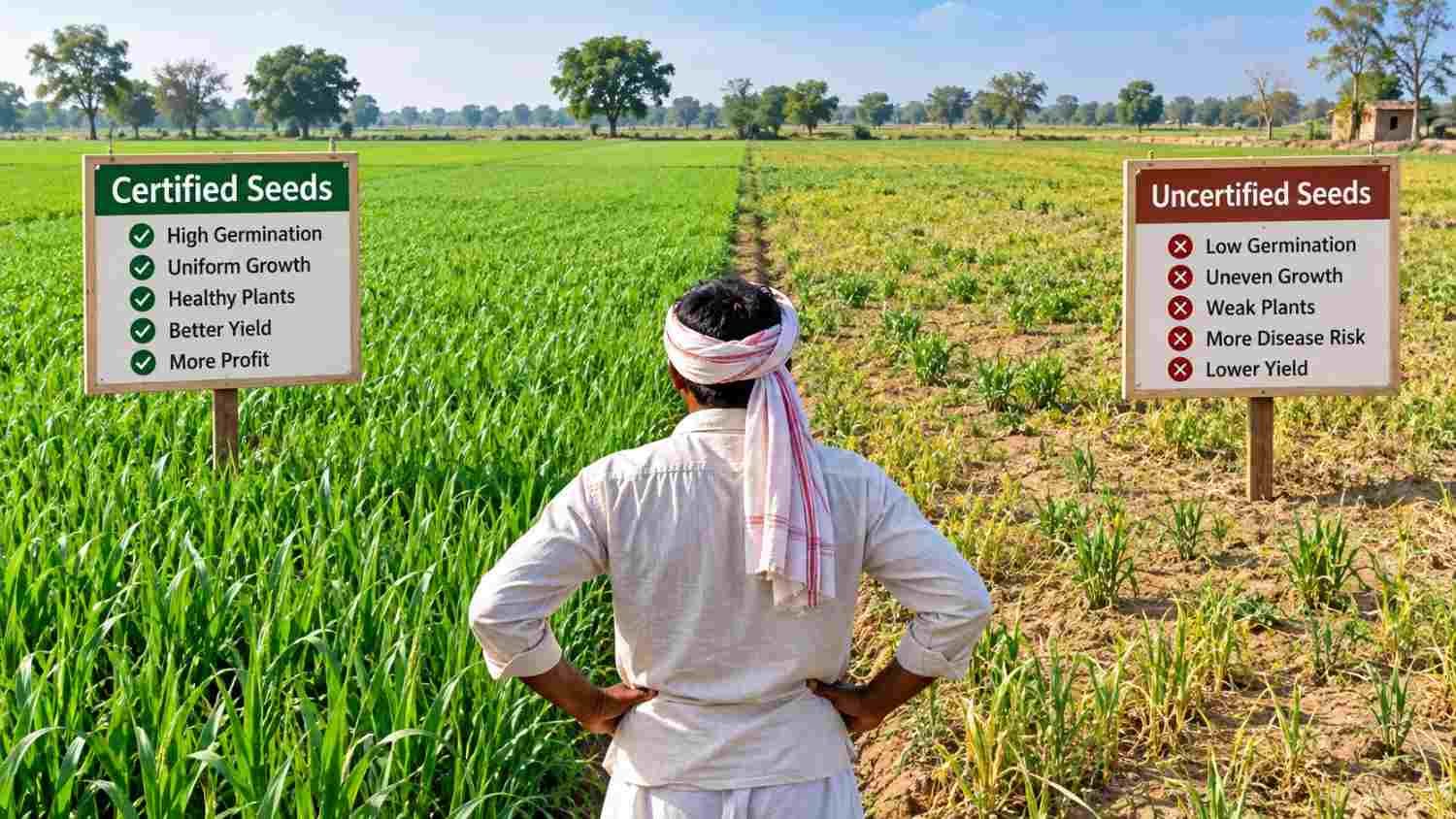
Certified Seeds vs Uncertified Seeds – Which One Should Farmers Choose?
Every farming season starts with one important decision: choosing the right seeds. When comparing certified seeds vs uncertified seeds, this choice directly impacts crop yield, quality, and farmer income. A wrong seed selection can lead to poor germination, disease-hit crops, and financial loss.
Many farmers in rural India still buy seeds from local vendors without checking quality. Some farmers also save seeds from the previous harvest without proper testing or verification. This practice often results in low germination rates and uneven crop growth across fields. Poor seed quality can lead to weak plants that struggle to resist pests and diseases. As a result, farmers may face unpredictable yields and reduced income from their crops. Understanding the difference between certified and uncertified seeds helps farmers make better decisions. Choosing certified seeds ensures higher quality, better yield, and more reliable farming outcomes.
In this article, we will explain what certified and uncertified seeds are, their key differences, benefits, risks, and how you can identify genuine certified seeds in India.
What Are Certified Seeds?
Certified seeds are those tested, verified, and approved by authorized seed certification agencies. These seeds meet strict standards for quality, genetic purity, and high germination rates. They are produced under controlled conditions with proper supervision at every stage. From field selection to packaging, all processes follow government-approved agricultural standards. This ensures farmers receive reliable, high-quality seeds for better crop growth and yield.
These seeds carry an official certification label that ensures verified quality standards. The label confirms the seed batch meets standards set by Indian certification authorities.
If you want to understand this in more detail, you can read our complete guide on what are certified seeds.
What Are Uncertified Seeds?
Uncertified seeds are seeds that have not gone through any official testing or quality check. These are usually:
- Farm-saved seeds from a previous harvest
- Seeds bought from unlicensed local dealers
- Seeds sold without proper labelling or tags
- Seeds with unknown or unverified source and history
Since there is no quality control, uncertified seeds may appear similar to certified seeds. However, they can vary greatly in purity, germination rate, and disease resistance.
Key Differences Between Certified and Uncertified Seeds
|
Feature |
Certified Seeds |
Uncertified Seeds |
|
Quality Testing |
Verified by certification agencies |
No testing or verification |
|
Germination Rate |
High and consistent (usually 80%+) |
Unpredictable, often low |
|
Genetic Purity |
Guaranteed true-to-type |
Risk of mixed or duplicate varieties |
|
Disease & Pest Resistance |
Screened for seed-borne diseases |
May carry hidden infections |
|
Packaging & Labelling |
Sealed with certification tag |
Often loose, unlabelled packaging |
|
Source Traceability |
Fully traceable to registered grower |
Unknown or unreliable source |
|
Yield Potential |
Higher and more stable |
Lower and inconsistent |
|
Government Support/Subsidy |
Often eligible |
Usually not eligible |
|
Price |
Slightly higher |
Cheaper upfront, but riskier |
This seed quality comparison shows that while uncertified seeds may seem cheaper at first, the hidden risks can cost farmers much more in the long run.
Benefits of Using Certified Seeds
Choosing certified seeds brings several real, on-ground advantages for farmers:
1. Higher and More Reliable Germination
Certified seeds go through strict germination testing, so farmers get more uniform plant growth across the field.
2. Better Crop Uniformity
Certified seeds are genetically pure, ensuring plants grow with uniform height and maturity. This uniform growth makes irrigation, spraying, and harvesting easier for farmers.
3. Disease-Free Planting Material
Certified seeds are checked for seed-borne diseases, reducing the risk of infections spreading early in the crop cycle.
4. Higher Yield Potential
Good quality seed is the foundation of a good harvest. Certified seeds are bred and tested to deliver better output per acre.
5. Access to Government Schemes
Many state agriculture departments and subsidy schemes require proof of certified seed purchase, which uncertified seeds cannot provide.
6. Peace of Mind
Farmers know exactly what variety and quality they are planting, reducing guesswork and risk.
These are some of the biggest benefits of certified seeds that make them a smarter long-term investment.
Risks of Using Uncertified Seeds
While uncertified seeds may look like an easy way to save money, they carry serious hidden risks:
- Poor and Uneven Germination – Some seeds may not sprout at all, leading to gaps in the field.
- Spread of Plant Diseases – Unchecked seeds can carry fungal, bacterial, or viral infections.
- Genetic Impurity – Mixed varieties can result in uneven crop maturity and reduced market value.
- Unpredictable Yield – Without quality assurance, output can vary drastically season to season.
- No Legal Recourse – If the seed fails, farmers have no certification proof to claim compensation.
- Long-Term Soil Impact – Poor quality seed batches can also affect soil health over repeated cycles.
These uncertified seeds risks often lead to financial loss that is much greater than the small amount saved while purchasing.
Why Certified Seeds Improve Crop Yield and Profit
Certified seeds are developed and tested to perform well under specific climate and soil conditions. Because they combine genetic purity with strong germination strength, they help farmers achieve:
- More plants per acre due to higher germination
- Stronger root systems and better nutrient uptake
- Reduced crop loss from disease
- Uniform harvest timing, which helps in better market pricing
This directly answers a common question farmers ask — why farmers should use certified seeds instead of relying on saved or local seeds. The seed cost is a small part of total farming expenses, but its impact on final yield and profit is huge.
Trusted seed companies like Agri Raise Crop Care Pvt. Ltd. work closely with certification standards to supply Indian farmers with reliable, high-performing seed varieties suited to local growing conditions. Choosing seeds from such trusted sources adds another layer of confidence for farmers.
How to Identify Certified Seeds in India
Not sure how to spot genuine certified seeds? Here's what to check before buying:
1. Certification Tag
Look for an official certification tag attached to the seed bag. It usually contains:
- Lot number
- Variety name
- Germination percentage
- Date of testing and expiry
- Certifying agency details
2. Government-Approved Labelling
Certified seed bags follow standards set under the Seeds Act and are monitored by state seed certification agencies.
3. Sealed and Tamper-Proof Packaging
Genuine certified seed packaging is properly sealed, not loose or repackaged.
4. Licensed Dealer
Always buy from an authorized dealer or a known company rather than an unregistered local seller.
5. Batch Traceability
You should be able to trace the seed back to a registered seed-producing farm or organization.
Conclusion
When comparing certified seeds vs uncertified seeds, the choice becomes clear once you look beyond the initial price tag. Certified seeds offer better germination, higher yield, disease protection, and long-term profitability — making them a much safer investment for Indian farmers.
Uncertified seeds may seem cheaper today, but the risks of poor germination, disease, and yield loss can cost farmers far more during harvest.
For better yield, better income, and peace of mind, always choose high-quality certified seeds from a trusted source.
If you want better yield and reliable farming results, choose certified seeds from trusted suppliers like Agri Raise Crop Care Pvt. Ltd. Explore our high-quality seed varieties and give your crops the best start.
Frequently Asked Questions (FAQs)
Q1. Are certified seeds more expensive than uncertified seeds?
Certified seeds usually cost slightly more upfront, but they offer better germination and yield, making them more cost-effective in the long run.
Q2. Can farmers reuse certified seeds for the next season?
It is not recommended, especially for hybrid varieties, as saved seeds often lose genetic purity and yield potential in the next generation.
Q3. How can I check if a seed is certified before buying?
Check for an official certification tag with lot number, germination percentage, and details of the certifying agency, and always buy from a licensed dealer.
Q4. Do certified seeds guarantee 100% crop success?
No seed can guarantee 100% success, as weather, soil, and farming practices also matter. However, certified seeds significantly reduce the risk of poor germination and disease.

Leave a comment


Comments(0)